Coming soon: Well-being of Wales report 2023

The annual Well-being of Wales report is due to be published on 28 September this year. This report will provide an update on well-being in Wales to help us assess whether we are making progress against the seven national well-being goals set out in the Well-being of Future Generations (Wales) Act 2015. The report considers progress against the 50 national indicators, alongside a range of other relevant data. The report is a key accountability mechanism, to be transparent about the progress Wales is making towards its well-being goals.

As in 2022, an easy read report will be published in addition to the main report to help ensure everyone is able to access statistical information about Wales.

Ethnicity and well-being supplementary report

We are committed to producing supplementary reports alongside the main report where there is a need to do so. This year we will publish a supplementary report alongside the Well-being of Wales report which focuses on ethnicity and well-being.

Throughout the development of the Anti-Racist Wales Action Plan, the availability of data and evidence was a recurring theme. Across the Welsh Government, we’re looking at how we can improve the evidence base on ethnicity, and the Well-being of Wales report is a part of this. It’s not currently possible to breakdown all national indicators by ethnic group, but there is more we can do right now to better tell the story on progress towards becoming a more equal Wales. The supplementary report aims to bring together existing evidence in order to explore progress towards the well-being goals for different ethnic groups. Alongside other types of evidence, this can be used to help inform decision-making to create a more equal Wales.

What else is new with this year’s report?

The first wave of national milestones were set in December 2021 and last year the Well-being of Wales report included reporting on these milestones for the first time. National milestones assist in measuring the pace of change needed to achieve the well-being goals. The second wave of national milestones were set in November 2022 and we will report on the complete set of national milestones for the first time this year.

The suite of outputs comprising the Well-being of Wales report and the dashboard of National Indicators were assessed by the Office for Statistical Regulation (OSR). They were given National Statistics status last year, which means they have been independently assessed as meeting the highest standards of trustworthiness, quality, and value. We’ve made some improvements this year based on feedback from the OSR as part of their assessment of this report. We’ve aimed to improve how we communicate any uncertainty in the data by putting short term changes in the context of long term trends. Where we use survey data, we have also commented on whether these changes are “statistically significant”, meaning they are unlikely to have occurred by chance. We are also developing a framework which sets out how we decide which types of data sources to use in this report and to measure the national indicators, which will be published ahead of next year’s release.

The Well-being of Wales page contains links to all previous Well-being of Wales reports, as well as data used in the reports, quality information, and national indicators. Check back on 28 September to see our “state of the nation” assessment for 2023.

Well-being of Wales report publication

On 29 September, we published the Wellbeing of Wales report, along with a separate report on children and young people’s well-being. We also published easy read versions of both reports. The suite of outputs comprising the Well-being of Wales report and the dashboard of National Indicators was given National Statistics status this year, which means it has been independently assessed as meeting the highest standards of trustworthiness, quality, and value.

How do you use the Well-being of Wales report?

We currently have some understanding of how the report is used, but we are always looking of ways to improve the report, and make the information we publish more accessible and suitable for a wide ranging audience. Understanding how the report is used is key to this.

To gather your views on how you use the well-being report and national indicators, and how they can be improved, we have created a survey form where you can provide your comments and suggestions.

Please provide your responses by 21 Nov 2022.

Thank you for taking the time to share your views and we look forward to hearing from you.

Looking ahead to this year’s Well-being of Wales report

The annual Well-being of Wales report is due to be published on 29 September this year. This report will provide an update on well-being in Wales to help us assess whether we are making progress against the seven national well-being goals set by the Well-being of Future Generations (Wales) Act 2015. The report considers progress against the 50 national indicators, alongside a range of other relevant data.

As in 2021, an easy read report will be published in addition to the main report to help ensure everyone is able to access statistical information about Wales.

In 2018, we published a separate report on well-being in children, alongside the main Well-being of Wales. This report included analysis of children’s well-being based on the Schools Health Research Network, as well as using the Millennium Cohort Study and other sources such as data on children in workless households from the Annual Population Survey. We’ve received feedback that there’s a gap in data on children, so this year we’ll be producing an updated children and young people’s well-being report alongside the main report.

What else is new with this year’s report?

This year will be the first time that the Well-being of Wales report will include reporting on the national milestones. National milestones assist in measuring the pace of change needed to achieve the well-being goals. The first wave of national milestones were set in December 2021 and will be reported on in this year’s Well-being of Wales report where data is available. The second wave of national milestones are currently being consulted on and are expected to be laid before the Senedd in October 2022.

In December 2021 we also laid an updated set of national indicators. We will be reporting on some of these new indicators for the first time this year. These include:

  • Percentage of people in employment, who are on permanent contracts (or on temporary contracts, and not seeking permanent employment) and who earn at least the real Living Wage
  • Pay difference for gender, disability and ethnicity
  • Proportion of employees whose pay is set by collective bargaining
  • Active global citizenship in Wales
  • Percentage of households spending 30% or more of their income on housing costs

We’ll update you here on this blog once the report is published, along with a request for your feedback on how we can keep improving it.

Mapping the national indicators to the well-being goals

In a previous blog post in January, we asked for your views on the current mapping of the national indicators to the seven well-being goals. Each indicator was mapped to one or more well-being goals when the indicators were originally set. This helps communicate how each indicator contributes towards achieving Wales’s well-being goals.

Thank you to those of you who responded to the survey. Based on your feedback, as well as discussion with a small group of people from the Welsh Government and other interested organisations, we decided to make some changes. We mapped indicators to additional goals where we felt that there was a clear link between the achievement of the goal and the item measured by the indicator, and we removed them where that link was now less clear.

Overall, we only made a small number of changes, which demonstrates that the original link between goals and indicators is still relevant. Most of the changes we made were for the globally responsible goal, where we asked ourselves “does a change in this indicator have an impact outside of Wales?”.

Indicator NumberIndicator NameChange in Goals
5Percentage of children with two or more healthy lifestyle behavioursAdd:
A Wales of vibrant culture and thriving Welsh language  
6Measurement of development of young childrenAdd:
A healthier Wales
11Percentage of businesses which are innovation-activeRemove:
A globally responsible Wales
16Percentage of people in employment, who are on permanent contracts (or on temporary contracts, and not seeking permanent employment) and who earn at least the real Living WageRemove:
A globally responsible Wales
18Percentage of people living in households in income poverty relative to the UK median: measured for children, working age and those of pension ageRemove:
A globally responsible Wales
19Percentage of people living in households in material deprivationRemove:
A globally responsible Wales
23Percentage who feel able to influence decisions affecting their local areaAdd:
A prosperous Wales
A resilient Wales
A healthier Wales
A Wales of vibrant culture and thriving Welsh language    

Remove:
A globally responsible Wales
28Percentage of people who volunteerAdd:
A prosperous Wales
A resilient Wales
A healthier Wales
A more equal Wales

Remove:
A globally responsible Wales
47Percentage of people who have confidence in the justice systemRemove:
A globally responsible Wales
48Percentage of journeys by walking, cycling or public transportRemove:
A globally responsible Wales

National Indicators: mapping the indicators to the well-being goals

In a previous post on the national indicators, we asked for your views on the set of national well-being indicators, and any gaps that the pandemic had highlighted as important to national well-being.

These indicators were set by Welsh Ministers to measure progress towards achieving the seven well-being goals. Each indicator was mapped to one or more well-being goals as part of the 2015-16 consultation and laying of indicators. Based on recent feedback, we would like to hear your views on the current mapping of indicators to goals to ensure this is still the best it can be.

What are the well-being goals?

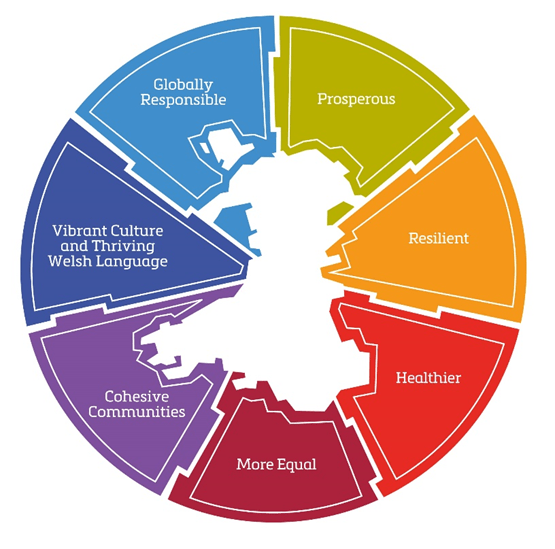
The seven well-being goals show the kind of Wales we want to see. Together they provide a shared vision for the public bodies listed in the Well-being of Future Generations Act to work towards. They are a set of goals – the Act makes it clear the listed public bodies must work to achieve all of the goals, not just one or two. The goals are:

  • A Prosperous Wales – An innovative, productive and low carbon society which recognises the limits of the global environment and therefore uses resources efficiently and proportionately (including acting on climate change); and which develops a skilled and well-educated population in an economy which generates wealth and provides employment opportunities, allowing people to take advantage of the wealth generated through securing decent work.
  • A Resilient Wales – A nation which maintains and enhances a bio-diverse natural environment with healthy functioning ecosystems that support social, economic and ecological resilience and the capacity to adapt to change (for example, climate change).
  • A Healthier Wales – A society in which people’s physical and mental well-being is maximised and in which choices and behaviours that benefit future health are understood.
  • A More Equal Wales – A society that enables people to fulfil their potential no matter what their background or circumstances (including their socio economic background and circumstances).
  • A Wales of Cohesive Communities – Attractive, viable, safe and well-connected communities.
  • A Wales of Vibrant Culture and Thriving Welsh Language – A society that promotes and protects culture, heritage and the Welsh language, and which encourages people to participate in the arts, sports and recreation.
  • A Globally Responsible Wales – A nation which, when doing anything to improve the economic, social, environmental and cultural well-being of Wales, takes account of whether doing such a thing may make a positive contribution to global well-being. Goal 7 recognises that in an inter-connected world what we do to make Wales a sustainable nation can have positive and adverse impacts outside of Wales.

The current mapping of indicators to goals can be seen in the infographic below and on the national indicator dashboard, or using the interactive mapping of indicators to Well-being and UN Sustainable Development Goals tool.

Re-mapping the indicators: How you can help

To gather your views on the mapping of national indicators to well-being goals, we have created a survey form which lets you allocate indicators to what you think are the best fitting goals. For each indicator you can assign goals, remove goals you feel are not appropriate for that indicator, or leave the current mapping as it is.

Before suggesting changes for an indicator, please make sure you are familiar with the description of the goal being added or removed. More information on the indicators can be found on the online webpages or in the technical description document.

Please provide your response by 11th February 2022

Thank you for taking the time to share your views, and happy mapping!

As always, you can send any comments or suggestions to the Shaping Wales’ Future mailbox.   

Email: ShapingWalesFuture@gov.wales